Visual Arts, Columbia University, New York

This course examines ways of looking and ways of seeing, both personally & professionally as artists and in a larger cultural context. Through field trips to contemporary art and other cultural sites, conversations with visiting critical thinkers and practicioners, readings, discussions, and visual & written responses, we will examine how we look, think, act, create and respond--critically questioning our own artistic practices and ways of looking at the world.

Monday, April 23, 2012

This is a Forgery (HC)


This is a Picasso work that I originally saw at the Guggenheim. In museums I typically spend a very short amount of time looking at each work, but if a work really hits me, then I have to super awkwardly stand in front of it for an uncomfortably long time. This work completely hit me in this way. I think it is perfect. It's sad and lonely and kind of romantic at the same time. I feel that Picasso conveys a lot of strength and confidence in his work, and I think it's great to see someone who's work is so strong try to convey a fragility or exhaustion in this woman.


I believe the work is still at the Guggenheim. If stealing it were a movie, I'd totally have to be lowered down from the ceiling through the empty center section of the museum. Once I had the piece, I would just keep it to have around. It kind of feels like it should be in a kitchen, but I still am indecisive about the room it would be in. I could see it in a library/music room/living room upstairs room in a hypothetical huge apartment in the West Village or SoHo or the like.

This is a Forgery (BD)


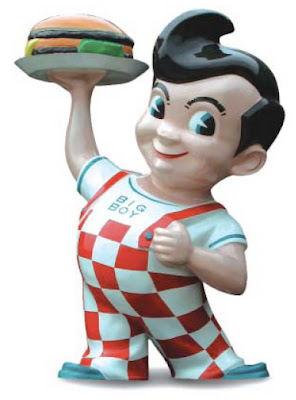
An object I have always wanted to get my hands on is the statue of Big Boy. These large 300 lb, 5 ft tall, fiberglass statues stand outside every Big Boy Restaurant franchise and have been the target of many thieves and vandals throughout history. My obsession with pop culture as well as my own personal history with the restaurant chain makes the statue a Holy Grail type object. When the statues have been stolen in the past, they have garnered large amounts of media attention. The statues are usually found or returned within days of their disappearance. The fact that so many people have tried to acquire the statues but have been unsuccessful makes the theft seem like a challenge I would readily accept.

Big Boy was one of the first national restaurant chains to be located near the small town where I grew up. I can remember eating there many times as a small child and always being fascinated with the statue. I would usually treat Big Boy like he was a real person. I would talk to him, hug him, pose for pictures with him, etc… The fact that Big Boy was standing out front inviting me to come dine made the restaurant my favorite place to eat as a 5 year old. Unfortunately, the quality of our local restaurant went downhill and my family stopped eating there. Soon after, the diner closed its doors for good. It was heartbreaking. At age 18 I moved to a larger city and discovered that Big Boy was still thriving there. It was also open 24 hours. Big Boy became part of many new memories, this time involving 3 am stops after a night of partying with friends. It was kind of like running into a friend from elementary school and picking up where things left off as adults. I found that, thanks to alcohol, I would still talk to, hug, and be photographed with my dear friend Big Boy.

That brings us to today, where I would love for Big Boy to come be my roommate. Stealing the statue will be difficult because many of the restaurants are open 24 hours. I will have to find a location in a small town that closes at least for a few hours at night so there is a chance at not been seen. Because the statue is so heavy, I will need a team of friends as well as a large truck to haul it with. This will be one time that it will pay off that most of my friends are degenerate hoodlums. Once we find the right location and the right team, it shouldn’t be hard to sneak in and grab the statue under the cover of darkness, although we will probably have to scope out the location in advance and maybe disable any spotlights a day or two in advance. The real trick will be replacing the real statue with a forgery so it will not be noticed. Actually, who am I kidding, I totally would want it to be noticed. Everyone that steals a Big Boy gets caught. Half the challenge and the fun is doing it and actually getting away with it. I would probably replace Big Boy with a ridiculous ransom note or a large pile of ground beef to signify the hamburger he was named after. My friends and I would then deliver Big Boy to where ever we would decide to store him, and then drive off to a 24 hour location of the restaurant to celebrate the success of the theft.


This is a Forgery (CR)


I've always been interested in Native American culture, so a few years ago I took a class on Native American art and artistic practices. This specific piece is a rug, a traditional Navajo flat-weaving from the 60's on show in the Denver Art Museum Collection. I'm so enthralled by the patterns on these pieces, and this is only one of thousands of examples. These pieces hold a really strong spiritual existence, as well as an artistic manifestation. Thus, a reproduction would skew the importance of the piece itself: first, I wouldn't be spiritually connected to the weaving, as the Dineh people that traditionally weave these pieces would be. Second, the artistic practice of weaving the rug would be artificial. The means of weaving are passed down through generations in a tribe, and I would thus externally receive knowledge about the practice, creating an insincere experience of creation in comparison to the original.

I've also read a lot of literature about appropriation of Native American culture. Especially in the 60's and 70's, with the New Age movement came a large influx of commercial objects with Native American symbols and themes attached to them. I've read numerous accounts of Native American reaction to this, and feel strongly against it. It turns a deeply rooted spiritual culture into a commodity for consumption, which is really devastating to me. Granted there are a number of tribes across the country that hold open ceremonies solely for tourist income. However, I'm just ver sensitive to the idea of taking cultural and spiritual symbolism and art objects and turning them into artificial objects only for consumption. With this in mind, if I ever were to go through and create a forgery of this piece, I wouldn't sell it, but rather keep it for my own personal reflection and/or use.

This is a Forgery (EB)


An image that I would like to forge will be one of Cezanne's "Card Players." This morning I read this article and it got me thinking about how there are so many question marks around "Card Players." I also remembered that about a year ago I went to the Met to see the exhibit, Cezanne's Card Players, and I was honestly shocked that instead of all five originals I saw only three and the other two were black and white photographs of the works. Huge disappointment!
From the article, it seems that there is a big mystery not only about how many watercolor studies Cezanne actually made, but also about the fact that the fifth oil painting is no where to me found. Sources claim that it might be either in Qatar, Greece, or Russia, but these are pure speculations. The article states, "Painting was said to be up for sale for $250 million. Some art dealers contend it was bought by the Qatar royal family; others speculate that it was purchased by the heir to another Greek shipping fortune, Philip Niarchos; still others say it could also have disappeared into a collection in Russia. But no one is saying for sure." So since it might be in my motherland, for this forgery assignment, I would like to claim that the missing Cezanne is actually in my possession and I am willing to put it up for an action while staying anonymous. I will probably hire a professional forger to create a masterful copy. Once uncovered this can become THE scandal of the century!

This is a Forgery (AY)


I used to dream of living at the Met, sleeping in the period rooms at night and eating cupcakes on the steps by day. I have since settled for knowing my way around it, finding new shortcuts and hiding places where you can stay a while and pretend you belong. One of my most coveted objects is one of the largest in the collection, the most permanent. It would be hard to move. At 115 x 84 1/8 inches, it's so big that if it was in my living room, I'd be living in a 19th century luxurious home, hanging out with these lounging ladies. It would become a stage set. I want it.

Since it's too big to forge (and I can't paint that well) I decide to steal it. Dressed as a promising and pretentious British curator I would convince the met to sign my papers for an important London art fair. With my papers, dressed in overalls, I would stay after hours with my team, dismantle it, fold it and hide it in the Japanese galleries. Take a nap. At the dead of night, we walk out. The painting would be folded, so it could be anything inside. Back in my dorm, I move all the furniture to the common room and remain alone with the painting. it is too big for my room so I have it at an angle. I curl up in the corner it makes with the wall and sleep soundly, dreaming of having such fabulous dresses.

This is a Forgery (RL)


I saw a documentary on PBS one time about Carhenge, a monument in the rural U.S.A. that imitates the formations of Stonehenge with automobiles instead of rocks. The man who made it had some interest in or was inspired by the original monument, and engaged with it by making a copy with materials that he had at hand. I wonder whether this desire to engage with something that inspires one is at the root of all copies and forgery. It is certainly true of musicians who cover songs by other musicians. The form of the thing is the same, but one's own hand and mind have been added to the equation. I'd always admired Frank Stella's paintings in museums and decided to make a copy of one of his black paintings in my own way. Making it, I was reminded of something an art teacher of mine said in the midst of a wave of academic cheating at our school: "art is the only discipline in which plagiarism is encouraged."


This is a Forgery (ES)


I have been obsessed with the View of Toledo for as long as I can remember. I’m not sure when or where I first saw an image of this painting, but all I knew is that I needed to see it in person someday. I’m not sure when I first saw the painting in person, but all I knew is I needed to own it. I’m not sure when I purchased my first poster with this image on it, but all I knew is that it wasn’t good enough. I’m not sure how I first broke into the Met to steal this painting, but all I knew was that I was going to walk up the stairs, turn right, and take what was rightfully mine. I’m not sure where the guards were when I replaced this painting with my framed poster, but all I knew is that no one would ever know. I’m not sure why I’m finally confessing all of this, but all I know is that nobody loves this painting as much as I do. I’m not sure if anyone is going to make a fuss about this painting being in the hands of its rightful owner, but all I know is that it is mine and it always will be –forever. I dare anyone to try to take it from me. I am not sure who Eduardo Santana is, but all I know is that I am Doménikos Theotokópoulos and people call me “El Greco”. I viewed this view first, and I should be the only one who gets to view it. [STOP]