The Artists Formerly Known As Eye & Idea
Columbia University Visual Arts 2014
Visual Arts, Columbia University, New York
This course examines ways of looking and ways of seeing, both personally & professionally as artists and in a larger cultural context. Through field trips to contemporary art and other cultural sites, conversations with visiting critical thinkers and practicioners, readings, discussions, and visual & written responses, we will examine how we look, think, act, create and respond--critically questioning our own artistic practices and ways of looking at the world.
Wednesday, April 3, 2013
I wanted to show you my favorite space again, since today it had its usual character (completely empty). The furniture is by Nakashima and the orchid is always there in the corner. The whole space delights me with its feeling of aesthetic repose amidst the visual frenzy that is the Metropolitan Museum. I like the tactility of the wood and the dimness. The calmness and smallness of the space, with its invitation to sit in quiet comfort, is like an opposite to all the rest of the museum. I hope you will all enjoy it in the future!
I was struck with the halo above Gabriel's head. The museum proposes specific sight lines, but sometimes looking above or below reveals something. I'm awfully fond of ceilings :)
I like to observe people in the museum to see what they want to look at. I have noticed that many take on something of the attitude, or share something in the arrangement of themselves with the works that surround them. Here life seems to be imitating art.
Maybe it's just the aura of the Met, but the fasteners and implements of display in this case felt like art, too!
Random, disjoint placard in bright orange--this one seems ironic in light of the current EU financial crisis.
Mirrors in the Met are interesting in how they reflect their surroundings. As a framed reflection, I wonder how much thought goes into their placement as a way to enhance the visibility of other objects.
I was struck with the halo above Gabriel's head. The museum proposes specific sight lines, but sometimes looking above or below reveals something. I'm awfully fond of ceilings :)
I like to observe people in the museum to see what they want to look at. I have noticed that many take on something of the attitude, or share something in the arrangement of themselves with the works that surround them. Here life seems to be imitating art.
Maybe it's just the aura of the Met, but the fasteners and implements of display in this case felt like art, too!
Random, disjoint placard in bright orange--this one seems ironic in light of the current EU financial crisis.
Mirrors in the Met are interesting in how they reflect their surroundings. As a framed reflection, I wonder how much thought goes into their placement as a way to enhance the visibility of other objects.
WTF MET
Constance showed us Auguste Rodin's marble sculpture "Cupid and Psyche" (ca. 1893), which is a work about love, divinity, the ideal form... and I found myself completely distracted by the opposite of these things: scratch marks all over the pedestal. I feel like the Met Museum is slacking.


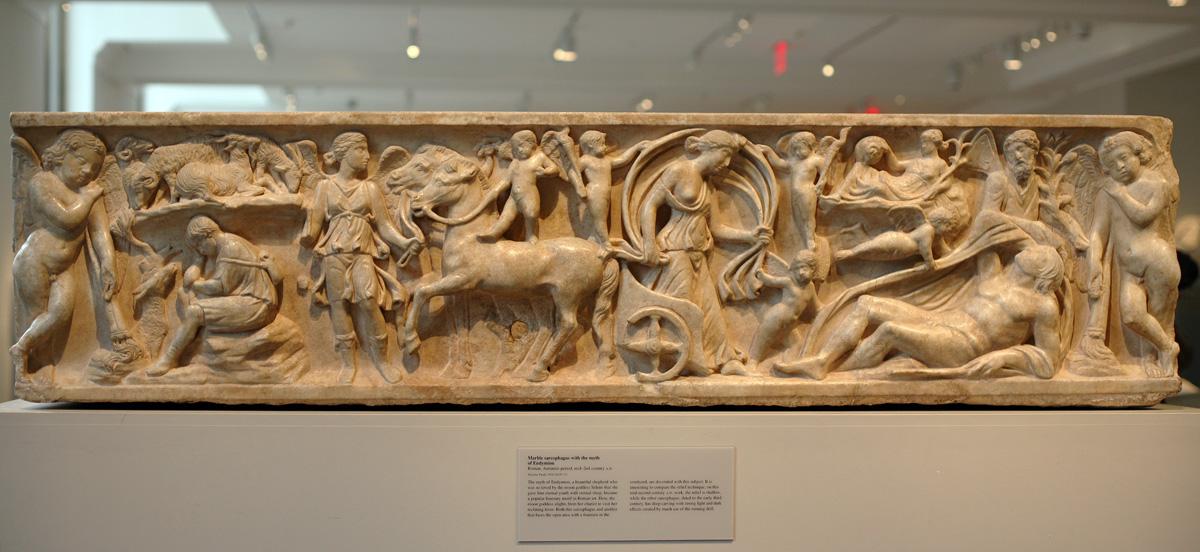
Endymion Sarcophagus
| Endymion Sarcophagus |
| Detail of Endymion Sarcophagus |
I suppose knowing the myth is key to appreciating the details of the sarcophagus. In the detail given above, Selene is seen descending from her chariot, her left foot having just touched ground, the shawl catching the wind. She is coming down from the heavens to visit her undying love. This detailing is then being used deliberately to display the intensity of the Selene's love for Endymion, of the deceased's love for whomever they left behind.
Show Me The Monet, They All Say
The Parc Monceau, 1876, Claude Monet - Clear Online version
The Parc Monceau, 1876, Claude Monet, Camera phone version
Extremely crowded places, like the Met, and people with sometimes nonexistent rules about personal space, really turns up my temperature. So, from what I could observe of my beloved Monet's Le Parc Monceau... give someone else the floor, steal another extended glimpse, give another gal or guy the floor, repeat, wait for yet another group of tourists to come, ooh and aah, and go off to the next whatever... repeat and repeat for nearly forty five minutes... the brush strokes on the right side of this striking painting, seem to form what I am calling, a figure of woman in a hat and not one, but two smaller figures (children?) following behind her, even though the second small figure is not fully outlined. Not only my gut, but something about my untrained artistic eyes tells me that I am one hundred percent correct.
The Hidden In Turner's Whale Ship
Turner was a master in creating drama and at the same time hiding what his paintings were about. He did this because he was suspicious of art critics and narrow-minded spectators. His intentions were to show the futility of human endeavor, but you had to look for them. When you see this painting on a normal distance you can hardly see the drowning fishermen in the three jollies. Only in going close up can you see them and their suffering and fear. Also that the whale is wounded by a harpoon needs to be seen close.
Subscribe to:
Posts (Atom)